
SNOW GOOSE
Her children were dead, her husband in critical condition. But Joy had not joined them that July evening for the little family outing, was not there when they were hit by a drunk in a speeding pick-up; Joy was unscathed. Which is to say, she was destroyed. It turns out death is not the problem. The problem is the terrible sorrow.
She spent her days in the dark, her pale eyes sallow in slate circles, like a lemur’s. She scratched and rubbed relentlessly. She said it felt as though her skin had developed electric cilia which were randomly shorting out. She couldn’t think what caused it.
Her childhood friend Amy came to cook, clean, feed the animals, and make Joy eat. The women of the Saving Grace Guild dropped off casseroles and soups, and Dr. Hegg stopped by to give sedation. Joy made an effort to speak, but her throat was thick with slag.
When Amy left she urged Joy to come. Joy pressed her hand to her mouth and shook her head— this was where theywere. So, promising to return, Amy went back to Enumclaw. It was a relief to both of them.
Joy sat. When the goats put up a racket she trudged to the barn and flung flakes of hay into their racks, and the horses’, and then hurried back to the house. She did not muck out the stalls.
Amy came again, vacuumed and scrubbed and dusted again. She washed the one sheet, towel, washcloth, dishcloth; she mucked out the barn and watered withered vegetables, too late to save them, but still Amy lingered in the garden with the hose running. Because Joy—she was too bright, like the face of Moses after he saw God. It made you want to avert your eyes; it evoked something like shame, even in a best friend like Amy or an old codger like Dr. Hegg. Terrible sorrow is hard to take.
This time when she left Amy chained Joy’s six-horse trailer to her pickup and took the horses and goats. The chickens had gone off.
Dr. Hegg visited a second time. He sat at the kitchen table in the muted glow of drawn shades and sipped fragrant jasmine tea. Joy sat across from him, her tea untouched.
Because sunlight hurts, she said. No, she wasn’t taking the medicine. She wanted to drive to Seattle. To see Jason.
But was she eating? How many hours’ sleep did she get? Did she visit with the church gals?
She prayed. They prayed.
She was what, not even thirty? She still had…but she had to hold on.
Her look said, what more could be done to me?
Was there no one—? Again, her look stopped him.
Perhaps she would do better in the hospital. Sleep, nutrition, support.
A psychiatric hospital? Joy said. I’m not going to kill myself. What if Jason wakes up?
But Joy did not know whether or not Dr. Hegg could force her and so, after a polite, desperate negotiation, she promised to eat, promised to take the Ambien, and promised to talk to a grief counselor. The doctor wrote on his white pad with his fountain pen and said he would be back in a week, though as it turned out, what with the Amos boy’s fall and the Garcia girl’s ectopic pregnancy, he telephoned instead.
Joy had met Jason, the lead singer for Lords of Light, at the Puyallup State Fair when she was seventeen and he was twenty-eight. He was wandering, waiting for a sound check, when he happened upon her in the goat barn, a skinny kid with braids and a farmer’s tan lying on her back with her head pillowed on the belly of a black-and-brown doe alongside another girl and seven more masticating goats. Just lying there, in the sweet, clean straw, like Jesus in the manger. The blue-and-white banner read Heavenly Hills 4-H. Jason believed it was divine providence.
He joked about the girls being livestock. They rolled their eyes. He studied the goats with interest and said that goats actually looked like devils with those horizontal pupils. He invited the girls backstage after his three o’clock concert, but Fitting & Showing was that afternoon and the girls declined. When he sauntered away, they looked at each other and waggled their hands. The guy was old, a bit intense, but was he hot or what.
Over the next three days, Jason learned about toplines, pasterns, hock width, udder attachment, and the general, graceful attribute called dairyness. Joy even let him milk, or try to milk, her most seasoned doe, Lily, who would put up with anything.
Joy was an only child, raised by her mother, Lydia, in Enumclaw, Washington, a small town in the shadow of Mt. Rainier. She started helping with the milking when she was seven and began showing goats at eight. She learned to clip hair, trim hooves, dehorn, castrate, vaccinate, inseminate. She snuck the babies into the house. One time, when she was ten, Joy became fed up with chores and told her mother that when she grew up she was going to live in an apartment in the city with only one goat.
Of course, she got over that. Joy was part of the team, forking straw and gathering eggs, smoking bee hives and trading out frames of honeycomb. When she got older she plucked stew roosters, singeing off the pinfeathers with a match. She learned to break their necks with her fast-pitch wind-up and then lop off their heads on the chopping block, one quick strike.
They also tried rabbits, but the rabbits made a terrible cry when you killed them—a baby’s mewl—and Joy’s mom decided they did not need to grow every single thing they ate.
Jason was also an only child, raised by his mom in Ventura, California, in a little stucco on a busy arterial. He told Joy his childhood was cheap. As a teen, he had gotten into trouble, girls, drinking, pot, and breaking-and-entering to “borrow” a guitar and, while he was at it, liberate the poor Rottweiler. He was a lost soul, he said. He didn’t know what he wanted, but it wasn’t Ventura High School, it wasn’t algebra homework and TV dinners by himself on the worn plaid couch in the den.
Jason’s second DUI conviction sentenced him to community service and Alcoholics Anonymous. He was scrupulous, carrying out the Twelve Steps to the letter. He apologized to various neighbors for theft, trespassing, late-night racket and the time he parked his Mom’s Lumina on Mrs. Sisk’s lawn. He offered to mow their grass for a year.
To his teachers he apologized for disrupting class, making fun of Ms. Anderson’s knee-hi’s, getting high, and offered to speak to the health class about drug abuse. His mother was harder. He said he was sorry. He didn’t know what to offer. She said she’d think about it.
When Jason discovered the Evangelical Free Church he pledged his life to Jesus Christ, and with a bass player from A.A. and an Evangelical drummer he formed Lords of Light. They recorded Jason’s compositions, No Stone, Lost & Found, Out the Other Side, Thank You. After that, along with remorse, Jason handed out CD’s.
They married after Joy graduated from high school, and within three months she was pregnant with their first child, Joshua, dark, intense and beautiful like his dad. Two years later, she had Daniel, the gray-eyed, sweet one. Joy had thought of herself and Jason as one, one object whose spaces were slippery and wet. With the two boys this object swelled, filled her almost to drowning with happiness. They all toured in the big silver bus.
But when Joshua turned five Joy insisted they stop. Josh needed friends; he needed school. And Joy needed roots. They found a run-down farmhouse on forty acres in the Skagit Valley north of Seattle and Joy put in a garden, salvaged the apple trees, and planted cherries. When Keep It Simple became a crossover hit, riding the top of Billboard for nine weeks, Jason built his dream recording studio. He also made appearances on Letterman, Good Morning America, and the Music Hour, and he picked up a weekly talk show on Spirit 105.3.
Joy, who loved to read, thought that once both boys were in school she might look into college, but she never did.
Through August and into September, Joy sat. She sat in the car on the long drive to the hospital, depressing the clutch, brake, accelerator; repositioning the gearshift. She sat in the gleaming hospital room: chrome, tubes, starched white linens; oxygen sighs and monitor beeps; the smell of alcohol and waste—while Jason’s eyes roamed behind closed lids. She sat at the wood table in her kitchen with an apple. She found some cheese, cooked a potato, then went and sat on the couch in the sunroom. Sometimes she tried to read in the broken silence. Sometimes she lay on the couch and tried to sleep. She never went upstairs.
And once a week, for fifty minutes, Joy sat in the grief counselor, Dr. Fales’s—Susan’s—office. Susan—contained, kind, and attentive, a tall woman with spacious brown eyes—told her that what she was experiencing was normal.
Normal.
But she must interrupt her thoughts when she began ruminating about the accident.
Ruminating. That’s what Dr. Fales—Susan—called the horrific pictures that played in Joy’s head.
Susan offered techniques to effect this interruption, like vigorous physical exercise and deep muscle relaxation. There was something called diver’s reflex, you could step into a cold shower or dunk your face in a bowl of ice water to disrupt difficult thoughts. Some people merely sprinkled the ice water on their wrists. Though it would be highly effective, Susan added, Joy should not jump into Puget Sound.
She studied Joy’s response—bright, blank, lifeless as ice—and then said, Okay. And singing will work, anything, like Mary Had A Little Lamb. Then she flushed and said, Just get yourself out of doors. Move. Outside.
Joy did not tell Susan that sunlight hurt.
Sometime in late September, Joy began to take the tortuous route to Seattle. Skydda Lane, Best Road, Brown’s Slough Road to Fir Island Road, past sagging farms to Warm Beach, McKee’s Beach—cheap developments—Priest Point; across the Tulalip Reservation into Marysville, then a jog through north Everett to the Pacific Highway. Joy knew her route made no sense. It took twice as long as I-5, two hours or more. And the accident had happened on a back road; most head-ons happened on two-laners. But Joy simply could not get on the freeway. One day she could, the next day she could not. So she had to go the hard way.
Tail lights, stoplights and windshield wipers. Joy opened the window and took the air in gulps.
The nurse Leila, assertive, solicitous, lovely Leila, who worshiped Jason, encouraged Joy to talk to him. She, Leila, spoke steadily in an upbeat, matter-of-fact manner as she changed his bedding, emptied his bags, and cleansed his body. She even provided Jason’s responses. But Joy could not make herself, not even when they were alone, so she whispered, Hello and Good night. She held his hand. She pretended they were praying.
Every week, Susan, who did not seem to mind repeating herself, said that what Joy was experiencing was normal. Joy was doing everything right. Her only job was to keep her physical body going.
Joy thought her job was to pray for Jason.
Okay. And time was Joy’s ally; the simple passage of time would help.
My ally. Time.
She just had to get through, brute force through her days until….
Until.
Sometimes Joy found respite in that quiet, featureless space. She could tell that Susan believed that she, Joy—what? Had a future, she guessed. Susan would hold it for her.
Jason regained consciousness in November during the night. Leila, who had pulled strings to keep him on her floor, was the one to tell him about the accident. Then she stayed into the morning to catch Joy. Leila apologized twice, three times. She couldn’t get Joy on the telephone, she said, and Jason had been so distressed—it would have been cruel not to tell him.
Joy thanked her. She didn’t mind that Leila told him as much as she minded the three apologies. By now, the words “I’m sorry” felt like little slaps.
Joy hurried to Jason’s room. He still lay in the high hospital bed with his head on the pillow as though his neck had wilted. His long hair was still stiff and tangled except for the shaved place, and his face was still waxen and sunken, with skinny tubes threaded into his nose. But the feeding tube was gone and his lids were half-up.
Tears brimmed and ran into his ears. Joy edged up to the bed, her hand extended.
Jason croaked, I am so sorry.
Threading herself through wires and tubing, Joy rested her cheek on Jason’s chest. She said, Oh, Jason, I didn’t know if you would wake up.
And then, nothing. Not a word about the children.
Susan said it was okay that Joy found no comfort in prayer, that it did not seem to make Joy as happy as she thought it would, Jason’s waking up.
Normal.
It was not okay—it was obscene—that someone had implied that Joy was lucky to have stayed at home that night.
Obscene.
Susan did not worry about the issue of feeling better. Life was something different now. “Better” might not look like what she was expecting. Was she getting outside at all?
No.
They sat, looking out the window at the rain and the ugly high-rise next door.
Driving home, Joy tried to remember if Susan ever touched her. It felt as though she had.
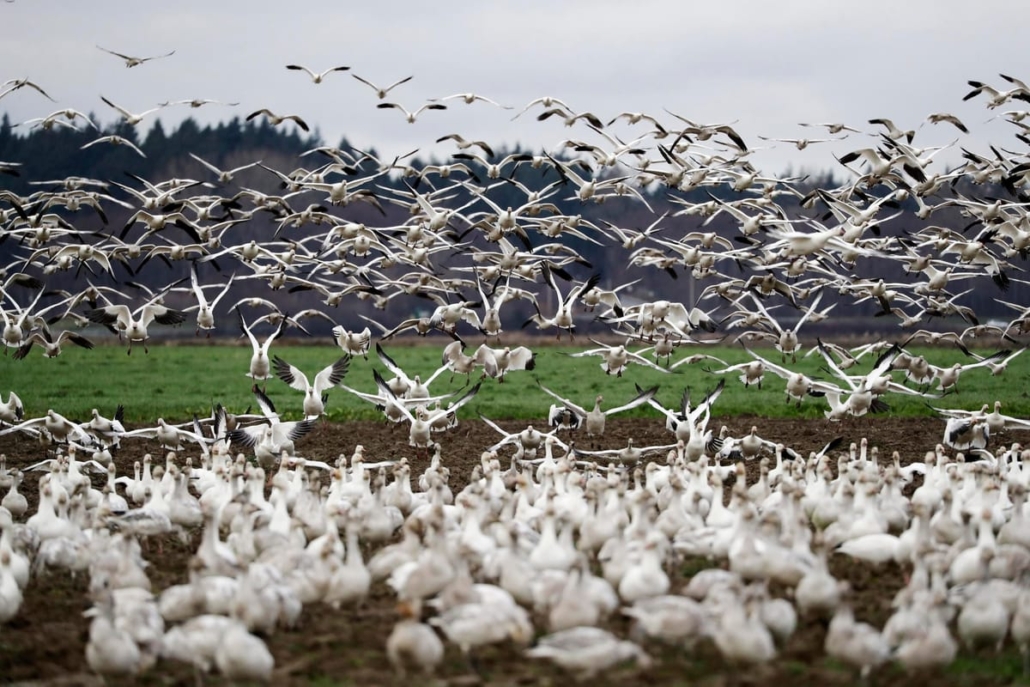
Late in November—Jason had been awake for seventeen days—Joy stepped off her back porch in the half-light before dawn in her pajamas and stumbled down the familiar stone path toward Jason’s studio. The body needs to move. The dim, mizzly world was motionless. Ahead, a white mass materialized and Joy stopped. She thought it was a mirage: a vast, shallow lake the color of lead floated a thousand white birds. Snow geese came to the valley every winter, but not to this field. And the Skagit River flooded every year, but never this pasture. If Joy had been listening to the news she would have known that between October 15 and November 20 the Pacific Northwest had received record rainfall; the entire valley was under water. But rain was routine, and Joy could not listen to the news.
She clambered over the soft berm. Mud coated her socks. She stepped onto the access road; the white mass shifted, heads swiveling, soft bodies sliding on water, and they cackled among themselves, not a general alarm but muted gabbles and clicks. Then that plangent cry.
That sound. It had forced her out.
Joy dropped to her knees and then onto her stomach across the muddy road, her forehead on her fists. She raised her head. The crushing clouds, the sullen water, the birds, that sound—she tucked her arms under her and lay back down, cheek on gravel. Then she raised up, flicked muddy water on her wrists, and lay down again. Rivulets trickled down pebbles to make tiny, iridescent moats in the mud.
It was the sound of Joy’s dreams. The sound of wailing children far away. The doctor had not warned her, or maybe he didn’t know, that the pills would make sleep a kind of twilit trance, that she would remember, and experience, her dreams.
Revenants.
Finally Joy raised her head. Move. She pushed herself to her knees and stood. The white mass riffled, clacked. Joy climbed back over the berm and strode across soggy vegetables to the barn, her heavy socks slapping. Inside the large, dark building, frigid and sepulchral without the livestock, Joy stomped to the feed room, wrestled the lid off a galvanized trashcan and scooped out a coffee can of oats. She replaced the lid and pounded the edge with her fist, which hurt, which gave her a grim satisfaction. She strode back across the garden, sliding on mildewed sunflower stalks; clambered over the berm; edged up to the water, and cast the oats.
The birds muttered, muddled about.
Joy turned, labored back over the berm, strode back to the barn, and flung the coffee can through the heavy wooden door.
Then she began to run. Down the gravel drive: ruined pajamas, mucky socks, long straggling hair and dirty face, a disaster survivor.
“The south pasture is completely under water.”
Leila had washed and combed Jason’s hair and changed his pale blue hospital gown, exposing sharp clavicles and the pulse in his throat. This shroud of a man reminded Joy of Edward Scissorhands, that beautiful.
After a pause Jason said in a dry whisper, “Wow. Never had that field go under, have we?” The rich timbre of his tenor, so loved by millions, was shredded. “I wonder what it means…” Jason’s world had always been lush with meaning.
“There were snow geese on it, like it was a lake. Hundreds of them. Thousands.”
“Snow geese,” he said, as though he were tasting the words. Jason’s brain, like his speech, was muffled and slow, but his drive, his curiosity, whatever the quality was that made him compelling, had awakened. His pine brown eyes sucked at Joy.
She looked at her hands. Her fingernails were thin sickles of mud.
“Is that right,” Jason said again. “Snow geese. Floating on the south pasture. I’d like to see that.”
Joy was breathing deeply, her hands clasping and unclasping. Move.
“Any swans?” Jason said.
“They make this sound, like—something sad.” Joy did not raise her eyes. Back from the dead.
Another pause. “Come here, Joysie.” Jason laid his hand, palm up, on the sheet. “Let me hold you.”
Joy stood up, dragged the heavy chair to the bed with a rubbery skreak, sat, and leaned forward. She took Jason’s hand in both of hers and turned it, examining the raised veins. Then she laid her cheek on his knuckles. She closed her eyes.
Susan said, ah, geese. Life.
Revenants. Revenants, revenants.
You weren’t there, you never saw them; death is hard to grapple with in the abstract.
No.
Oh, too bad, Susan said. Because with Skydda Lane now flooded, Joy had to take Dodge Valley to Best Road. She had to drive past the Rexville Grocery.
Don’t look. Don’t think. Just breathe.
Joy watched Susan’s mouth. She was doing everything right. The body needed to move.
Early the next morning before she left for the hospital Joy pulled on her mother’s old duct-taped parka, which she’d kept—that and the Frye boots—after her mother’s death from breast cancer. Fingering the small abalone shell in the pocket, a birth-gift from her mother’s brother, Joy trudged to the barn and then the pasture. Where are you?
She threw grain into the glutinous lake and watched the white birds mill about like a crowd in a four-way crosswalk. Overhead, gulls circled and shrieked, and a big raptor, a vaporous blur, perched in the snag on the far side. The geese would not approach, but Joy told herself she did not care. Let the gulls have the oats. She just wanted the walk to the barn. She wanted the smell of the straw, the sweet alfalfa, the oats’ molasses. She wanted the weight of a full coffee can in her hand, the pull on her arm, the familiar feel in her shoulder of swinging that can, something other than the brick on her chest and the burning in her throat, that bitter aspirin taste; anything, thighs, nose, fingers; hot, cold, anything. She was not feeding the geese. The geese were nothing.
“I don’t think there are any swans. At least, I couldn’t tell. Do they…um…”
“…Flock?”
“Together?”
“Yeah. Sometimes.” Jason was gazing out the window. He had told Joy and Leila that he could not get enough cloud—iron white weighted with charcoal, thick with purpose and heavy with healing.
He turned back to Joy. His chapped lips had relaxed into a smile. “Remember that time over by the dike, what was it, two years ago? That huge flock of geese?” Jason said. “Must have been thousands there, too…”
No.
Jason did not notice.
“Remember the eagles? Eight, right? …on the ground, flapping and leaping like marionettes, like they were playing a game with each other. Or with some poor rabbit…”
Then he looked at Joy.
They had gone down to the dike with the boys, five and seven at the time, and Josh and Daniel had started running after the birds. They’d spotted the eagles just as Jason snared the excited boys. This is what God will give you, Jason had told them. Dancing eagles. A reward for showing respect to His creatures.
“Oh, honey, I’m so sorry. Joy. I am so sorry.”
“I know you are.”
Dawn. The water was receding, exposing alluvial mounds on which the geese roosted. Their undersides were caked with mud. The juveniles were gray. As Joy drew near they snapped up, half-spread their wings, and then hopped and flapped away, honking. But they didn’t fly. She flushed bunch after bunch, flap, waddle, and settle again on a new muddy hump to nibble at their wings as though waiting to be served. No swans.
Joy wondered if they would stay all winter.
“But I thought you weren’t really a Christian anymore.”
The other driver, the drunken driver, was here, in this hospital. In Joy’s mind he was dead, pale, bloated, with puffy hands and foul breath.
For Jason, he conjured forgiveness. “Come on, Joy. We’ve talked about this.” Jason paused. “Because I left the church? That’s Pastor Sullivan. My faith has never wavered.” He closed his eyes. Every day, he asked to get up.
“Do you need to rest?”
“I am not going to do anything without talking to you first. You know that. But I wanted you to know.”
“Do you need to rest?”
Without raising his head, Jason opened his eyes.
“Don’t go,” he said.
Susan said feeling could be seen as improvement. Anger. Of course.
Normal.
It was life.
No.
Life returning to her as it had to the pasture.
No.
She was doing everything right.
But where did they go?
They sat together. They watched it rain. Susan did not mind Joy’s silence.
Joy watched her husband.
“Did they tell you what room he’s in?”
Jason rolled his head on the pillow. “Leila was not supposed to tell me he was here.”
“You cannot forgive the person who took your children. It is too much.”
After a minute, “God does not ask anything of us that is too much.”
Joy shook her head. She pressed her lips together. She swallowed, and then swallowed again.
“Joy, I am not asking you to forgive him.” Jason coughed. “I am only saying I must. I must try. It’s who I am.” That zeal, that strict scrupulosity, easier to admire in an idol. She had loved it once.
Joy wiped her cheeks. In the mirror her colorless eyes looked like Tanka’s, her wifty appaloosa’s, when he thought he saw a snake.
“Are you writing a song about it?”
Jason rolled his head, one long-fingered hand to his brow. The I.V. ticked.
Joy punctured the silence. “What happened. That night. How did it happen?”
Jason reached out. Ticking. Huffs and hisses and squeaks. The blurred garble of the Public Address system. Finally he dropped his hand and turned toward Joy.
“I don’t know,” in a hoarse whisper. “I have no memory. Nothing. Not even pulling out onto Dodge Valley. No memory of the truck, no memory of the crash, no memory of anything until I woke up here.”
“Okay, then, what do you remember? What happened at the grocery, what happened in the parking lot, what did—”
“Joy. Stop.” Though his lips were stiff, his gaze was clement, the gaze he gave to the boys after a nightmare.
“What kind of ice cream did Daniel get? I know Josh had chocolate, but what did Daniel want?”
It had been unusually hot. After washing up, Joy had gone to the porch to watch the sun sink into Skagit Bay. Jason did not join her because he wanted to take the boys for a treat. He had been irritable for months, conflicts with his pastor and his manager, and he had again scolded at dinner. Joy had not wanted them to go. It was late; they needed baths. But Jason had insisted. A quick run to Rexville’s and then he’d help her get them to bed.
Joy stopped just inside the door. Jason was sitting in a chair, flushed, with a blanket over his lap.
“Joy, this is Tom Keegan. From the New York Times.” Joy had thought the elegant, crisp man holding a notebook was that man, though of course he couldn’t be, straight and tall in his chinos and dark jacket.
“He has come to interview me about, you know, how the recovery is going.”
Joy nodded.
“Hello, Mrs. Treeling. I am sorry for your loss.”
Joy nodded again. She looked at Jason.
“Could I speak to Jason for a minute, please?” She did not address the man.
“Of course. I’ll go to the cafeteria. Be back in fifteen minutes?”
“Sounds good,” Jason said.
The journalist pushed through the thick wheezing door. Joy waited until it clicked.
“Where did he come from?” she said carefully.
“He called a while back. You know, while I was out.” Joy did not return Jason’s wry smile.
“We don’t have to talk to him.”
“No.”
“I don’t want to. I think it is obscene how people want all the—like vultures sucking up what’s left.”
“I don’t think he’s like that, Joy. I spoke with him at length.” Jason laid his head back. “Tom is interested in the redemptive aspects of…what happened.”
“What does that mean?”
Jason slowly lifted his head and sighed. “Well, you know. My beliefs. Healing. Forgiveness…. The meeting with Roy Andersen.”
“What does that mean?”
“Roy Andersen has agreed to meet with me.”
Joy stared at him. “You said you wouldn’t do anything without talking to me.”
Jason nodded. He placed both hands on the arms of his chair and with great effort shifted his seat. “I know. I know I did. I have prayed and prayed on it. What is the highest good here? Oh Joysie, I—Joy?”
Joy had abruptly raised both hands. “You’re meeting that man with a reporter?” she hissed. “You’re doing this for publicity?”
Joy stood at the edge of the field. The sun was a weak smear behind the scrim of cloud. The water lay in thick, opaque swaths, cold and mineral. She watched geese rip at sod. Somewhere. She turned, climbed the berm, and trudged toward the barn. She stopped to stare at Jason’s studio, weathered cedar with windows all around like an observation tower. She considered going in. Singing will work. Her mouth filled and she spat. She spat again and continued to the barn.
She hauled open the heavy door, pushed a brick against it with the toe of her boot, marched across the dank space, and grabbed a worn rung of the vertical ladder. The litter in the loft was labyrinthed with slender, hand-swept paths. But so cold. Joy pulled herself up and crawled carefully across loose straw until her hand landed on something sharp. Tyrannosaurus Rex, the large, lifelike, hard-rubber one. Daniel’s. She cradled it to her chest and lay there, inhaling dust. Finally, she got too cold; she was shaking.
She relinquished the dinosaur back to its grave with a wordless prayer. Then she crawled to the ladder, stumbled down, and stalked to the feed room, where she scooped grain and took off.
Now she was sweating, breathing in gulps, her mouth flooding as though she were about to retch. Some geese had begun to roost, some still worked the sod. She scrambled over the berm. Life returning. Sing to them. She dropped the can. She spat, hands hanging. She studied the birds, then snatched the little abalone from her pocket and hurled it. The geese nibbled. Another fallow moment, and then Joy ran at them. The ground was coated—puddles, sludge, shit—and twice she lost her footing, but she caught herself and charged ahead as geese honked, whistled, flapped, coggled.
Finally they lifted off in great whoofing skeins, wingtips black against the hoary sky. Except two—running, honking and flapping, two could not take off. Joy lunged and landed on them, snaring one meaty wing. The animal squalled; its free wing slashed her face as the other bird sped away. Joy rolled, her muddy hair plastered across her neck and chin, and clutched the goose to her belly. She smelled blood, a sticky substance oozing from neat holes on its chest, and her hand jumped as though the holes were hot. She gripped the ropy neck and pushed herself to her feet.
She bent over, panting, dangling the limp bird carelessly. Life is something different now. Her throat was sick with bile. Again she spat. The flock flew farther, braying like hounds. Like the cries of children. No. Suddenly the heavy bird in Joy’s grasp thrashed and shrieked. No. The weight in her hand, the pull on her shoulder. It’s time for you to go.
Joy windmilled her arm around and around and around until she felt the neck snap and the goose go limp. She let loose, and the dead white bird flew across the darkening sky.